
Auschwitz-Birkenau: 1.1 Million Walked In and Never Walked Out
Take a moment. 1.1 million people.
That number is almost impossible for the human mind to comprehend. So perhaps the only way to begin is to stop thinking about the number and think about the people.
People who had names. Families. Homes. Jobs. Children. Parents. Dreams. Suitcases packed with belongings they believed they would need for whatever came next.
1.1 million walked in and never walked out.

Auschwitz
Our private journey to Auschwitz-Birkenau with Krakow Direct began with our driver, Konrad, who was excellent from the moment he picked us up. Professional, punctual and thoughtful, he understood the significance of the day and made the journey comfortable while allowing space for the quiet that naturally accompanies such a visit. Then we arrived, and the words on the page became real.
Walking in their footsteps. The tour takes you on a journey of approximately two and a half hours, walking through the grounds and buildings where these events actually happened. You are not simply being told a history.
You are walking through it. At the beginning of the tour, names of victims are quietly announced. One after another. Names of people who once lived, loved, worried, laughed and dreamed. It is a small gesture, but standing there listening, you realise why it matters. Because the Nazis tried to turn people into numbers. The memorial gives some of those people their names back.
Stripped of everything. As we moved through Auschwitz, the enormity of what happened began to reveal itself through the belongings left behind. Behind glass were thousands upon thousands of shoes, of all sizes. Then suitcases, Cooking pots. Spectacles piled up; personal possessions and jewellery had been stripped from them and sold. Then you are taken aback by an enormous quantity of human hair that had been cut from prisoners and collected by the Nazis for use in their war economy. To put it in perspective, the display revealed two tons of human hair.
You stand looking at these objects and realise that every single item belonged to someone.
A suitcase represented a person who believed they were going somewhere.
A child’s shoe belonged to a child who should have been running through a playground.
A cooking pot belonged to someone who thought they would need to prepare another meal.
Glasses belonged to someone who needed them to see.
And the sheer volume of these possessions becomes a devastating visual representation of how many human beings were stripped of everything they owned.
Not just their possessions. Their identity. Their dignity. Their humanity.
From people to numbers
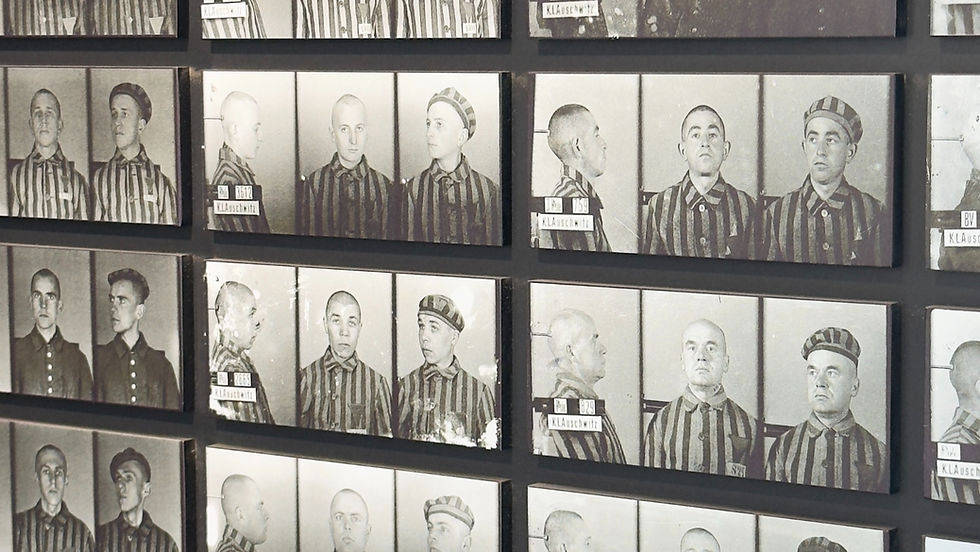
Prisoners were tattooed with identification numbers, reducing human beings to something resembling an inventory system, or being branded like livestock.
It is difficult to stand there and comprehend how methodically people were dehumanised.
Names became numbers. Families became groups to be separated. People became categories. And eventually, for millions, people became statistics. Yet every statistic represented a human life.
The selection
Perhaps one of the most confronting parts of the history is learning what happened when deportees arrived. Many were transported here believing they were being relocated or taken somewhere they could start again. They arrived by train directly into the camp with their possessions, their families and whatever hope they had managed to hold onto.
Instead, they faced a selection process. Doctors and SS personnel assessed people as they arrived and directed them into different lines. One direction could mean temporary selection for forced labour. The other could mean almost certain death.
For many women with children, young children, elderly people and others considered unable to work, there was no meaningful choice at all. They were generally sent directly to the queue, which they did not know led to the gas chamber, but just a shower and a better life.
There were horrifying exceptions. Twins, for example, were sometimes selected for medical experimentation because of the Nazis’ interest in conducting racial and genetic experiments.
Imagine arriving at a place you believe may be the beginning of a new life, only to discover that someone standing in front of you can point left or right and determine whether you live or die.
That single gesture could decide your fate.
Every building tells another story.
Every building, corridor and display revealed another layer of unimaginable suffering.
The preserved belongings, the cramped barracks, the punishment cells, the death block, the gas chamber and the remnants of the machinery of genocide transformed history from words on a page into something painfully real.
Seeing these places with your own eyes feels profoundly different.
You can read about overcrowding, starvation, punishment and systematic murder in a history book, but standing inside the cramped barracks and punishment cells gives those words a physical reality.
The buildings are silent now. But the silence feels heavy.
The journey to nowhere
Perhaps the most haunting aspect is understanding the deception.
People were often encouraged to believe that they were being taken somewhere safe. They were told to mark or remember their luggage. They arrived with belongings that they expected to reclaim.
Instead, they were led through a process designed to strip away every last possession and ultimately their lives.
The journey they believed might lead to somewhere better became their final journey.
And walking through the buildings and grounds today, knowing what happened next, makes that deception almost impossible to comprehend.
Birkenau
Then you reach Birkenau. The scale is overwhelming.
Birkenau, with its vast expanse stretching into the distance, was perhaps the most confronting part of the visit.
Standing beside the railway tracks where families arrived, often unaware of the fate awaiting them, it became impossible not to imagine the fear, confusion, and heartbreak so many experienced.
The railway tracks stretch into the camp, bringing thousands upon thousands of people directly into the machinery of mass murder.
Standing there, looking across the enormous grounds, it is difficult to understand how this could have existed.
But perhaps the hardest thing is not the scale.
It is imagining the individuals within it. The mother holding her child’s hand. The father carrying a suitcase. The elderly person trying to keep up. The child who didn't understand what was happening. The person wearing the shoes you saw behind glass. The person whose name was quietly spoken at the beginning of the tour.
Suddenly, 1.1 million is no longer just a number. It becomes 1.1 million individual lives.
A place you don’t leave unchanged
It is difficult to describe the emotions that accompany this visit. It is heavy. It is confronting. It is heartbreaking.
The overwhelming feeling is not simply sadness, but disbelief that human beings could inflict such calculated cruelty upon other human beings.
The complete disregard for life, dignity and compassion is almost impossible to comprehend.
Walking the grounds where so much cruelty occurred, seeing the conditions people were forced to endure and witnessing the sheer volume of belongings left behind is something that stays with you.
Our on-site guide was informative, knowledgeable and respectful, helping us understand the history without sensationalising it.
That's precisely why visiting Auschwitz-Birkenau matters. The memorial is not about dwelling on the past. It is about understanding it.
It reminds us where hatred, prejudice and dehumanisation can lead when left unchecked. Every visitor becomes part of the promise that these stories will keep being told. That is why Auschwitz-Birkenau is not simply somewhere to visit for its historical significance.
It is somewhere to remember. To learn. To confront. And to understand what can happen when prejudice, hatred and dehumanisation are allowed to become a system.
This is not a destination you leave saying you enjoyed. It is a place you leave carrying with you. And perhaps that is exactly how it should be.
1.1 million walked in and never walked out. Take a moment.


I’m just returning from Terazin (Prague) concentration camp and feeling the same sadness, yet deeper understanding of the depth and breadth of the mass annihilation conducted in the name of Nazi Germany. We also toured Dachau a couple years ago.
This article is so well written and descriptive of how it FEELS to visit these horrible places. Thank you Sally and Wayne for taking the time to share your experiences with all your fans.
PS. Ironically, a few nights ago on a running commentary on WW2 by Tom Hanks, it showed Auschwitz and other concentration camps in and around Poland. It was very graphic. Kind regards, PK.
Hi Sal & Wayne. Thank you for that extraordinary writing of how mankind can carry out such inhuman and barbaric acts, and on such a scale. It needs to be told and not hidden. I too have visited Auschwitz, over 45 years ago. The photographs, buildings, rooms, gas chambers, ovens, shoes, glasses, suitcases never leave you. Well done for going. Best regards & safe travels. x
Such an important story to tell although such a hard thing to face as it is so hard to accept this was all carried out by other humans. I actually don't know how to process this. As always great to see you both well and thriving!
Thank you for this informative but very sad post. I had a choice of this excursion in our upcoming cruise down the Danube but couldn’t do it. I couldn’t witness the evil and not unsee the atrocities executed from one human to another. It would’ve been hell on earth.